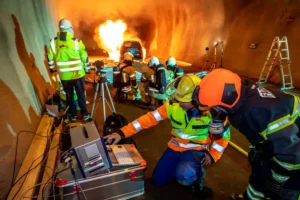
Source: https://www.tugraz.at/en/news/article/brandversuche-zeigen-oesterreichs-tunnel-sind-fit-fuer-e-autos0
Electric Vehicle Fires in Tunnels: passive fire protection perspective
The rise of electric vehicles (EVs) has prompted research and changes across many aspects of transportation infrastructure, including tunnel safety. Fire protection in tunnels is a crucial area where new technologies, like EVs, require reassessment and adjustment. As EVs, including trucks and buses, become more prevalent, it’s vital to understand the unique risks they present in tunnel environments, particularly when it comes to fire safety. This blog post explores the risks of electric vehicle fires in tunnels, examining maximum heat release rates (HRR), risk comparisons with internal combustion engine (ICE) vehicles, and findings from full-scale fire tests conducted globally.
Risk Analysis of EV Fires in Tunnels
Electric vehicles present a unique fire risk profile compared to traditional ICE vehicles. A significant risk lies in the lithium-ion batteries, which, when involved in a fire, can lead to prolonged burning and thermal runaway. This phenomenon, where the temperature of the battery continues to rise and propagate from one cell to another, can create a challenging situation for firefighting efforts, especially in confined tunnel environments.
In tunnels, the restricted ventilation and limited access for emergency services make it particularly difficult to manage fires. The combination of battery fires and confined tunnel spaces increases the likelihood of rapid temperature escalation, toxic smoke production, and extended firefighting durations. Additionally, electric trucks and buses, which carry larger battery packs, present an even greater risk, requiring additional considerations for tunnel design, ventilation, and emergency response plans.
Some EV buses are equipped with battery packs in the roof structure. This increases risk of damage to the tunnel structure due to a shorter distance between the potential source of fire and concrete lining that can be heated.
Maximum Heat Release Rates (HRR) of EV fires
One of the most critical aspects of fire safety analysis is understanding the maximum heat release rate (HRR). For ICE vehicles, typical HRR values range between 5-10 MW for passenger cars and up to 30-50 MW for larger trucks and buses. Electric vehicles can exhibit similar HRR values.
Recent full-scale fire tests carried out by tunnelling authorities around the world, such as those by the SP Technical Research Institute of Sweden and the Federal Highway Research Institute in Germany, have shown that the HRR for a typical electric passenger car can reach up to 7-8 MW, which is comparable to a modern ICE vehicle.
From this perspective structural integrity of tunnels during EV fires is safe. Tunnels are usually designed for much higher HRR’s, like 100MW or in case of RWS fire curve, even up to 200-300MW.
However, the difference lies in the duration and persistence of the peak HRR.
EV fires often are characterised by a sustained peak HRR over a more extended period, which can increase the thermal load on tunnel linings and ventilation systems.
For electric buses and trucks, the situation is even more concerning. Full-scale tests have demonstrated that electric buses can reach HRR values of 20-30 MW, with electric trucks potentially exceeding these figures. The high energy density of the batteries, combined with the large mass of these vehicles, contributes to the increased fire intensity. This highlights the need for improved ventilation capacity and enhanced firefighting provisions in tunnels designed to accommodate heavy EV traffic.
A

EV fire compared to other type of vehicles – source: https://www.sciencedirect.com/science/article/pii/S0306261922017548
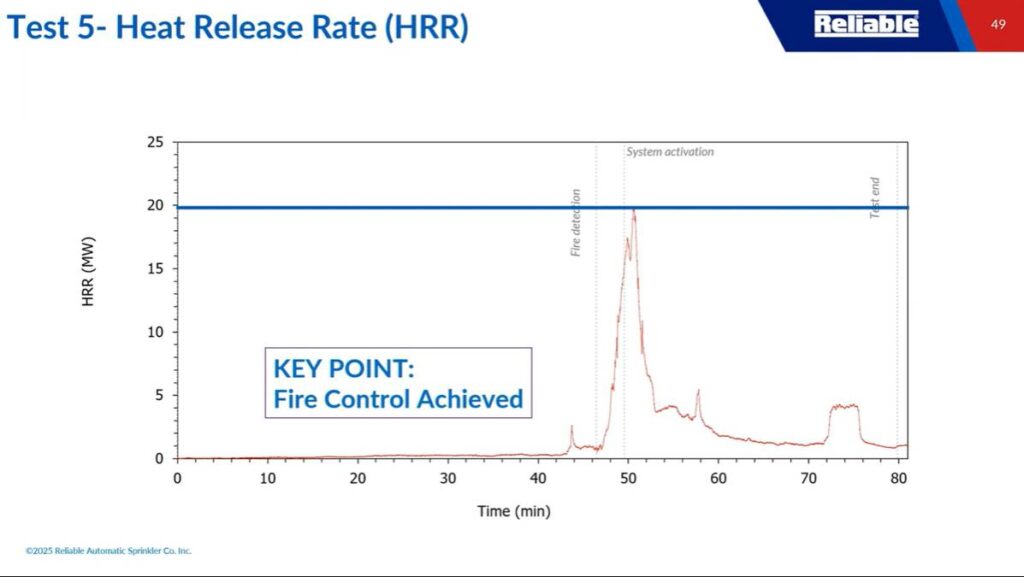
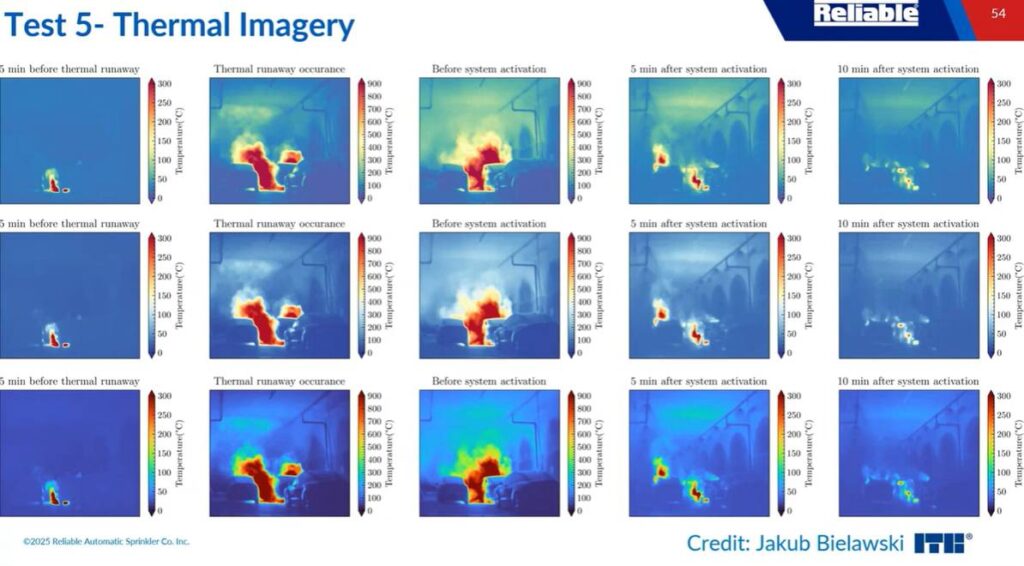
In 2025, Reliable Sprinklers, carried out another fire test investigating EV fire scenario in tunnels.
Three Tesla Model 3’s & an ICE vehicles were tested. All Teslas had their batteries at 100% SOC (State of charge). There was a pan with diesel under the battery. The diesel pool was ignited to provoke thermal runway. It took almost 45 minutes before thermal runway occurred.
Maximum HRR during the fire of all vehicles was just below 20MW. Shortly after Reliable Sprinklers system was activated. A few minutes later the temperature and HRR dropped significantly.
You can watch the webinar explaining the testing done by Reliable Sprinklers: Large-scale Fire Testing for Tunnel Applications.
EV fire vs ICE vehicle fire
When comparing EVs to ICE vehicles in terms of fire safety, several important distinctions emerge. ICE vehicle fires are typically characterized by rapid fuel involvement and flame spread, often reaching peak HRR faster but with a shorter overall burn duration. In contrast, EV fires tend to have a slower onset but can sustain high temperatures for extended periods due to the thermal runaway of battery cells.
The differences in toxic smoke production are also significant. ICE fires generate carbon monoxide, hydrocarbons, and other toxic gases, whereas EV fires produce a different cocktail of hazardous chemicals, including hydrogen fluoride and other toxic fluorinated gases. This difference in gas composition necessitates careful consideration in tunnel ventilation system design, as the appropriate strategies for handling toxic smoke may vary.
Battery fire safety becomes an important topic. Not only for tunnels, but also for residential applications where electric bikes or scooters are parked or stored more frequently. The Research Institute of Sweden published numerous findings from these topics. There are also articles related to electric vehicle fires and extensive paper titled Electric Vehicle Fire Safety in Enclosed Spaces which covers the topic of EV fires in tunnels and underground car parks.
Full scale EV fire tests in tunnels
In Austria Graz University of Technology (TU Graz), the University of Leoben, the Austrian Fire Brigade Association and the consulting firm ILF Consulting Engineers Austria, supported by ASFINAG (Austrian road authority) and the Federal Ministry for Climate Protection, Environment, Energy, Mobility, Innovation and Technology researched the effect of electric vehicle fires in tunnels. You can find more information in the linked article, the research paper here and also in the interview with the lead researcher prof. Peter Sturm here.
One of the main conclusions from that interview can be presented with the following quote:
“Do you have any idea how bad the tunnel fire will be if there is an EV involved?
That is a question I hear a lot, way more often than I would like. And usually, my answers do not get approval. I guess telling people “doesn’t matter, passenger vehicles are not a concern” does not rank very well against all the media chaos related to challenges with these new energy carriers. “
Role of fire boards in electric vehicle fires in tunnels
The main role of fire boards during any fire in tunnel is to protect the tunnel structure from elevated temperatures that can damage structural elements.
In NFPA’s article regarding electric vehicle fire considerations for tunnel fire protection this matter is also listed. The authors state that “Ultimately, the tunnel, regardless of category, should be designed so that it can withstand at least 120 minutes of fire exposure.”
Even though this statement lacks further details about intensity of the fire, we can find that information in NFPA 502 which refers to RWS 120 fire curve requirements.
Tunnel fire boards, like Aestuver Tx, are already designed for harshest tunnel environments. When we look at the data from laboratory fires and full scale tunnel fire test we can see that the heat release rate of EVs during fire is comparable to HRR of ICE vehicles. What is more, as presented in the research in Korea (Sungwook Kang et al.) the temperature during BEV fire barely reaches 1000°C.
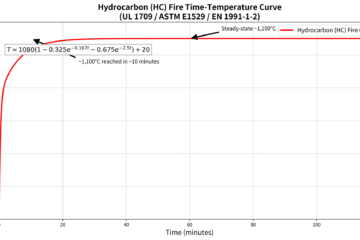
Currently numerous tunnels are designed up to RWS fire curve requirements, where fire reaches 1350°C for 60min. This is much higher than the temperatures measured during electric vehicle fire.
Aestuver Tx tunnel fire boards comply with NFPA 502 requirements and also with RWS 120 and RWS 180 fire curves.
Tunnel fires of EV Trucks and Buses: An Emerging Challenge
The transition to electric heavy vehicles, such as trucks and buses, presents an even greater challenge for tunnel fire protection. With larger battery packs, these vehicles pose a higher fire load compared to passenger EVs or ICE counterparts. Full-scale fire testing on electric buses has indicated that the fire may reach a similar peak HRR as a diesel bus, but the energy released over time is more prolonged, which can cause more extensive damage to tunnel infrastructure.
Given the increased risk, enhanced safety measures are essential for tunnels that expect frequent electric truck or bus traffic. These measures include improved fire suppression systems, more robust ventilation designs capable of handling higher heat and smoke loads, and updated emergency response protocols that account for the specific risks posed by battery fires, including the potential for re-ignition even after initial suppression.
Hasan Raza from the University of Buffalo and S. Li wrote the paper The impact of battery electric bus fire on road tunnel.
This desktop study analysis the influence of EV bus fire on tunnel safety aspects like fire protection, ventilation and evacuation. As the authors wrote “Results show temperatures higher than the ASTM E119 and ISO 834 curves for a period of longer than 10 minutes on the tunnel ceiling for the BEB fire with natural ventilation.”
However, the graph included in the study shows that temperatures are stil much lower than in case of the RWS fire curve which is most adapted for modern road tunnel designs.
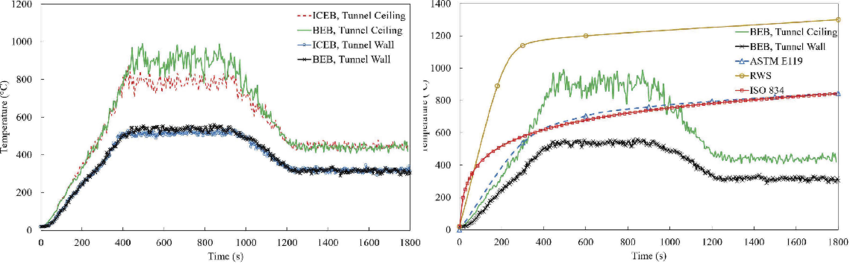
Tunnel ceiling and wall temperatures comparison between internal combustion engine bus and battery electric bus (BEB) fire (left), and tunnel ceiling and wall temperatures from BEB fire compared with standard fire curves (right), source:https://www.researchgate.net/publication/370546754_The_impact_of_battery_electric_bus_fire_on_road_tunnel
Conclusion:
- Heat Release Rate of EVs during fire is comparable to ICE vehicles and tunnel structures are designed for 10x or even 20x higher HRR.
- Passive fire protection in tunnels, like Aestuver Tx fire boards systems is also designed for much higher intensity of fires
- Prolonged Heat Release – EV fires, particularly involving larger vehicles like buses and trucks, exhibit prolonged high HRR, putting greater stress on tunnel infrastructure.
- Thermal Runaway – The potential for thermal runaway in lithium-ion batteries creates challenges for firefighting and requires advanced suppression techniques.
- Toxic Smoke – Different toxic gases produced by EV fires necessitate modifications to tunnel ventilation systems to protect occupants and emergency responders.
- Heavy EVs – The introduction of electric trucks and buses requires more stringent tunnel fire safety designs to accommodate the higher fire load and extended burn duration.
Electric vehicles are here to stay, and with them comes the need for tunnels to adapt to a new fire risk landscape. The unique characteristics of EV fires, including the high and sustained heat release rates and the specific challenges associated with battery fires, require a reassessment of fire protection measures in tunnels. By learning from full-scale fire tests and adjusting tunnel designs and emergency response plans accordingly, we can ensure that tunnels remain safe for all road users, regardless of the type of vehicle they drive.
Based on the studies carried out concerning EV fires in tunnels, the peak heat release rates vary from 5MW to 10MW. These values are comparable to ICE vehicle fires.
Similar findings are presented by Bartosz Miechówka &· Wojciech Węgrzyński in their Systematic Literature Review on Passenger Car Fire Experiments for Car Park Safety Design.
Research papers cited above provide details about the electric car fire temperature which reaches not more than 1000°C. Such temperature is also developed during ICE vehicle fire. Although that number may seem high, in fact it’s lower than maximum temperature used for design of tunnels. Currently most used design fire curve is RWS which requires tunnels to be resistant to 1350°C.

0 Comments