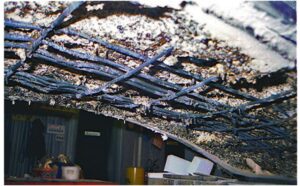
Example of concrete spalling with exposed reinforcement – https://www.researchgate.net/publication/270777740_Fire_spalling_of_concrete_-_A_historical_overview
Concrete Spalling in Tunnel Fires: Causes, Effects, and Prevention
Concrete spalling is a critical concern in tunnel engineering, especially when it comes to fire protection. As tunnels become increasingly vital for transportation and infrastructure, ensuring their resistance against fire-induced damage is paramount. This blog post delves into the phenomenon of concrete spalling in tunnel fires, exploring tunnel design fire curves, the temperatures at which spalling occurs, and referencing scientific studies that shed light on this issue.
What is Concrete Spalling?
Concrete spalling refers to the breaking, chipping, or flaking of concrete surfaces, which can compromise the structural integrity of tunnels during fires. Spalling occurs when the surface layer of concrete deteriorates, often due to rapid temperature changes or the presence of moisture within the concrete matrix. In tunnel environments, spalling can lead to reduced load-bearing capacity, increased vulnerability to collapse, and hindered evacuation efforts during emergencies.
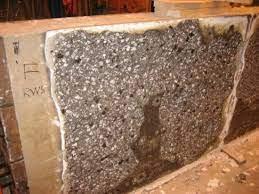
Tunnel lining specimen after fire test with visible spalling – source: “Spalling of fire exposed concrete” – https://www.researchgate.net/publication/327700745_Spalling_of_fire_exposed_concrete
Tunnel Design Fire Curves
Tunnel design fire curves are essential tools used to model the temperature development within a tunnel during a fire. These curves help engineers predict the thermal behaviour of tunnel materials, including concrete, under various fire scenarios. According to the Eurocode 1, standard fire curves like the ISO 834 are commonly employed to simulate realistic fire conditions in tunnel design.
Key Fire Curves in Tunnel Design:
- ISO 834 Fire Curve: Represents a standard time-temperature relationship for structural fire design.
- RWS Fire Curve: The most severe scenario of tunnel fire with rapid raise in temperature reaching 1350°C within 60 minutes
- HCM: designed to reflect extreme fire conditions, particularly those involving large quantities of flammable materials, such as hydrocarbons.
Understanding these fire curves allows engineers to design tunnels that can withstand high temperatures and mitigate the risk of concrete spalling.
Temperatures at which concrete can spall
It’s incredibly difficult to predict at which temperature concrete will spall. There are multiple characteristics that effect this process. Empirical studies and researchers provide quite a large span of temperatures. Some concrete mixes can spall in low temperatures, below 200°C (392°F) and others above 380°C (716°F).
However, the exact temperature at which spalling begins can vary based on several factors:
- Moisture Content: High moisture within concrete can lead to explosive spalling as water vaporizes rapidly.
- Concrete Composition: The presence of certain aggregates and the quality of the concrete mix influence spalling resistance.
- Heating Rate: Rapid temperature increases can exacerbate spalling by not allowing sufficient time for moisture to escape.
- Applicable loads: when concrete structure works under compression, there’s a high risk of spalling – Mindeguia et al 2013
- Concrete strength: higher strength concrete mixes tend to spall more due to lower
Scientific studies, such as those by Spence et al. (2005) and Huang and Cai (2010), have extensively analyzed the thermal properties of concrete and identified critical temperatures that contribute to spalling. These studies emphasize the importance of controlling moisture content and using appropriate concrete mixes to enhance fire resistance.
Historically two major tunnel fires that changed the entire fire protection industry also resulted in concrete spalling and partial damage of tunnel structure. These were Mont Blanc Tunnel fire and Channel Tunnel fire.
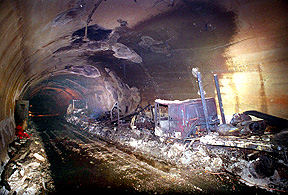

Mont Blanc Tunnel after fire (left) and Channel Tunnel lining after fire (right) – spalling clearly visible (source: http://www.porousmedia.nl/nfcmr/Restop30.html)
Mitigation Strategies for Concrete Spalling in Tunnel Fires
Preventing concrete spalling in tunnel fires involves a combination of design strategies and material choices:
- Low-Permeability Concrete: Using concrete mixes with reduced permeability minimizes moisture ingress, lowering the risk of vapor pressure build-up.
- Fiber-Reinforced Concrete: Incorporating fibers, such as polypropylene, can help control crack propagation and enhance spalling resistance. Nevertheless, fibres don’t remove the risk of spalling completely. Without conducting a fire test, there’s no assurance whether the specific mix will be spalling free. What is more, the fibres in concrete can protect the structure only once. After a fire the damaged concrete layer has to be removed and repaired which can lead to significant costs and delays for commuters using the tunnel.
- Fire protection boards which work as an insulation layer: Adding tunnel fire protection materials around concrete structures can help maintain lower surface temperatures during a fire. Aestuver fire boards were tested for numerous fire curves and multiple specification requirements. Most popular demand from tunnel projects is to keep the concrete surface temperature under 380°C (716°F) and temperature of reinforcement under 250°C (482°F). Compared to the polypropylene fibres, Aestuver fire boards are more economical solution in the tunnel lifetime.

Implementing these strategies during the design and construction phases significantly reduces the likelihood of concrete spalling, ensuring tunnel safety and longevity.
Conclusion
Concrete spalling poses a significant threat to the structural integrity and safety of tunnels during fires. By understanding the underlying causes, such as high temperatures and moisture content, and implementing effective mitigation strategies with tunnel passive fire protection systems, engineers can design tunnels that are resilient against fire-induced damage. Staying informed through scientific research and adhering to established design fire curves ensures that tunnel infrastructure remains robust and safe for years to come.
For more insights on tunnel safety and fire protection, stay tuned to our blog and subscribe for the latest updates in civil engineering and infrastructure resilience.
If you want to deeper dive into the spalling phenomenon, please refer to the following papers:
Fire spalling behavior of high-strength concrete : a critical review
Spalling of fire exposed concrete
Fire spalling of concrete – A historical overview
Fire-Induced Spalling Behavior of Concrete: A Review
Investigation of the Concrete Lining after the Mont Blanc Tunnel Fire
- Spence, G., Wang, R., & Ng, C. (2005). Fire Resistance of Concrete Structures. Fire Science Publications.
- Huang, Y., & Cai, W. (2010). “Experimental Study on Concrete Spalling Induced by Fire.” Journal of Structural Engineering, 136(8), 1025-1034.
- Kafaza, E., & Osman, S. (2012). “Moisture-Induced Spalling in Tunnel Concrete Structures.” International Journal of Concrete Structures and Materials, 6(4), 189-198.
- Eurocode 1: Actions on Structures – Part 1-2: General Actions – Thermal Actions.

11 Comments
RWS fire curve - Tunnel Passive Fire protection - fire boards and fire cladding · 29 November 2024 at 11:16 am
[…] which expanded on the testing of fire protection systems and included assessments of concrete spalling behaviour during […]
Passive Fire Protection in Tunnels - an introduction · 29 November 2024 at 11:16 am
[…] begin to spall (crack and lose pieces) at around 300-400°C, and melt at even higher temperatures. Concrete spalling and it’s extreme version in the form of explosive spalling poses critical risk for tunnel […]
How to select the right fire board for tunnels - Fire Protection · 29 November 2024 at 11:17 am
[…] There is also a tendency for tunnel projects to carry out bespoke fire tests related to the specific tunnel project. These tests happen either in-situ, in case of the old tunnel that requires renovation. Or in a fire testing laboratory using the concrete slab built from the specified mix. It allows to test both the fire boards and tunnel concrete mix for spalling. […]
What is the lifetime cost of tunnel fire protection panels? - Tunnel Passive Fire protection - fire boards and fire cladding · 29 November 2024 at 11:21 am
[…] chose Damage Level 4 for a tunnel without any fire protection boards. This is further defined as spalling in a large area with exposed […]
RWS火曲线 · 11 December 2025 at 1:53 pm
[…] 所列的测试流程。最初的测试指南可追溯至1986年TNO发布的《BI-86-69 隧道防护防火测试程序》报告,其中采用新开发的RWS火灾曲线模拟碳氢化合物火灾,对混凝土板进行了测试。1998年,RWS与TNO(现Efectis荷兰公司)联合制定了更全面的《1998-CVB-R1161(修订版1)——隧道防火规范》,该文件扩展了防火系统测试范围,并新增了火灾中混凝土剥落行为的评估内容。 […]
ISO curve - ISO 834 time-temperature fire curve · 17 December 2025 at 9:38 pm
[…] simplicity, the ISO curve is a fundamental tool for analyzing fire exposure in building components. Concrete spalling, a phenomenon which causes concrete damage due to fire also can […]
Hvordan velge riktig brannplate til tunneler · 17 March 2026 at 9:12 am
[…] Dette gjør det mulig å teste både brannplatene og tunnelbetongblandingen for avskalling. […]
Jaka płyta tunelowa zapewni najlepszą ogniochronność? · 17 March 2026 at 10:08 am
[…] W projektach tunelowych obserwuje się również tendencję do przeprowadzania testów ogniowych dostosowanych do konkretnego projektu tunelu. Testy te odbywają się albo na miejscu, w przypadku starego tunelu wymagającego renowacji, albo w laboratorium testów ogniowych przy użyciu płyty betonowej wykonanej z określonej mieszanki. Pozwala to zbadać zarówno płyty ppoż, jak i mieszankę betonową tunelu pod kątem odpryskiwania. […]
Cómo elegir el panel ignífugo adecuado para túneles · 25 March 2026 at 8:54 am
[…] También existe una tendencia en los proyectos de túneles a realizar ensayos de resistencia al fuego a medida relacionados con el proyecto específico del túnel. Estos ensayos se realizan in situ, en el caso de un túnel antiguo que requiera renovación. O en un laboratorio de ensayos de resistencia al fuego utilizando la losa de hormigón construida con la mezcla especificada. Esto permite probar tanto los paneles ignífugos como la mezcla de hormigón del túnel para detectar desprendimientos. […]
Hydrocarbon Fire Curve · 1 April 2026 at 1:21 pm
[…] concrete spalling can be a severe phenomenon under the HC fire curve? Rapid temperature increase causes thermal shock […]
Krzywa węglowodorowa · 2 April 2026 at 11:57 am
[…] odpryskiwanie betonu może być poważnym zjawiskiem w ramach krzywej pożarowej HC? Gwałtowny wzrost temperatury […]