
Aestuver Tx fire protection board for tunnels
Fire boards for tunnels are an important asset that protects integrity of the structure. Safety is paramount, and passive fire protection in tunnels is a critical consideration. Selecting the right fire protection board for your tunnel project is essential to ensure the safety of users and infrastructure in the event of a fire. Fire boards form part of the fire protection system that provides these crucial safeguards in case of a fire:
- Tunnel Stability: The structure remains strong and secure, preventing collapse.
- Usability Maintained: The tunnel won’t suffer lasting damage that would block passage.
This article will equip you with the knowledge to make an informed decision.
Fire board for tunnels
Before diving into specifics of fire boards, it’s crucial to understand your tunnel project’s unique requirements. Here are some key factors to consider:
- Tunnel type: Is it a cut-and-cover tunnel, immersed tube, or TBM tunnel? Different construction methods necessitate different fireproofing approaches.
You can utilise Aestuver fire boards in all tunnel types.
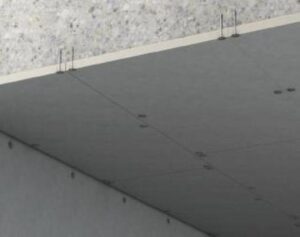
Tunnel fire boards – fixed directly to the tunnel ceiling
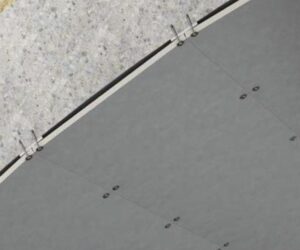
Tunnel fire boards with the backing strips
Thanks to its optimal dimensions you can easily apply Aestuver fire boards on the curved tunnel walls. Fire protection panels are 625mm wide making them easy to fit the tunnel curvature. 10mm backing strips behind the joints help installers to overcome tunnel surface tolerance and make installation easier.
- Fire resistance rating: Local regulations will dictate the required fire resistance time for the boards. This translates to how long the boards must maintain structural integrity under extreme heat. Different countries specify different requirements. The most popular fire curve applied for tunnels fire protection is RWS fire curve.
| Country | Norm | Tunnel type | Tunnel Fire Curve |
| Austria | OVBB | Road and rail tunnels | RWS – 3h |
| Belgium | Efectis-R0695:2020 Fire testing procedure for concrete tunnel linings and other tunnel components | Road tunnels | RWS |
| Belgium | CETU | Road tunnels | N0 – no fire curve N1 – ISO – 2h N2 – HCM – 2h N3 – ISO – 4h & HCM 2h |
| China | GB 28376-2012 | Road tunnels | RABT 90 + 110 |
| France | CETU | Road tunnels | N0 – no fire curve N1 – ISO – 2h N2 – HCM – 2h N3 – ISO – 4h & HCM 2h |
| Germany | RABT | Road tunnels | RABT – 30 + 110 |
| Germany | ZTV/EBA | Rail tunnels | RABT 60/90 + 110 |
| Italy | UNI 11076 – Test procedures for evaluation of the behaviour of protective materials, applied to underground construction’s ceilings, under fire conditions | Road and rail tunnels | RWS |
| The Netherlands | Efectis-R0695:2020 Fire testing procedure for concrete tunnel linings and other tunnel components | Road tunnels | RWS |
| Singapore | LTAS | Road tunnels | RWS |
| USA | NFPA 502 – Standard for Road Tunnels, Bridges, and Other Limited Access Highways | Road tunnels | RWS |
- Environmental conditions: Fire boards for tunnels cannot be only defined by fire protection. Environment in tunnels is relatively harsh for any building materials. Depending on the location and nature of the tunnels you might deal with high humidity, freezing temperatures,, corrosion, chemical impact, suction & pressure effect and abrasion just to name a few. A fire board which is suitable for indoor conditions may not do so well in the tunnel.
- A great example of excellent tunnel fire board is Aestuver Tx. This fire protection panels was engineered for difficult tunnel conditions. It has Type X surface classification (based on EAD 350142-00-1106) which means it can withstand chemical testing, abrasion testing, freeze-thaw testing. These boards are proven to handle outdoor conditions, having passed tests based on the ÖBV guideline for fireproofing upgrades in underground transportation structures. They’ve also been tested and confirmed to withstand freezing and thawing cycles.
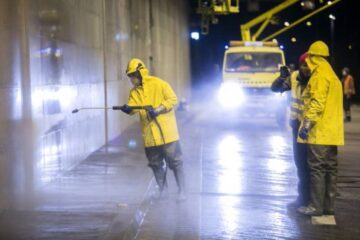
- Each road tunnel accumulates dirt and fumes on its assets. Tunnel operators need to clean it regularly to maintain safe visibility and sufficient light reflectance. Aestuver fire boards for tunnels are easy to clean using standard methods, including steam or water jets, and work well with cleaning chemicals. Tunnel cleaning machines can safely clean the surface of Aestuver tunnel fire protection panels.

Photo from a road tunnel with cleaned fire protection panels next to the old, dirty panels.
Cleaning tunnel fire boards with High-Pressure Water Jets:
- Use a minimum distance of 50cm when using a pressure washer with 100 bar of pressure.
- For lower pressure washers (20 bar), stay at least 20cm away from the board.
These recommendations are based on tests following DIN EN ISO 11998 and ensure effective cleaning without damaging the boards. The good news is that Aestuver® fire protection boards don’t require any special coatings or waterproofing for these cleaning methods!
You can find more details about the fire board product testing in the ETA documents – European Technical Assessment.
“AESTUVER Tx fire protective boards are suitable for use in the following use categories specified in ETAG 018-1, with no essential changes in their fire protective properties to be expected.”Essential characteristic Performance Resistance to deterioration caused by water Resistant in accordance with EN 12467, (for Type X4 and Type Z15) clause 7.3.53 Resistance to soak/dry Resistant in accordance with EN 12467, (for Type X4 and Type Z15) clause 7.3.6 Resistance to freeze/thaw Resistant in accordance with EN 12467, (for Type X4 and Type Z15) clause 7.4.1 Resistance to heat/rain Resistant in accordance with EN 12467, (for Type X4 and Type Z15) clause 7.4.2

Installation considerations for tunnel fire boards:
Think about the complexity of the tunnel’s geometry. Some boards are easier to install on curved surfaces than others. Aestuver BSP, Aestuver T board and Aestuver Tx tunnel fire board are suitable for both square and round section tunnels.
Another aspect which plays a crucial role during installation is the material weight. 25mm thick Aestuver Tx tunnel fire board weights only approximately 21kg/m2. Such fire protection panel is easy to handle without the need for mechanical lifting equipment. Contractors use from two to three fixers for installation of these tunnel fire boards with a standard size of 2600x625mm.
Cutting and Processing of tunnel board:
Aestuver tunnel fire boards can be cut with several tools:
Standard tools: A handheld circular saw with a dust extractor (ideally a plunge saw) or a stationary panel saw will do the job.
Clean cuts: For the best results, use carbide-tipped saw blades with alternating teeth.
Less dust: Blades with fewer teeth and slower cutting speeds will create less dust.
Need to make more intricate cuts? No problem! You can use a jigsaw, router, or hole saw for further shaping and adjustments.
Remember: Always use dust extraction while cutting any board material, and keep the extractor running for a bit after finishing to clear any remaining dust particles.
Aestuver fire boards for tunnels can be installed in two different ways. First one is called post-fix system and is most popular. Fixers use nail anchors to attach fire boards to tunnel structure. These anchors, are usually from Etanco, Fischer or Hilti. Of course in case of using anchors for fire boards for tunnels these must be at least stainless steel grade 1.4401 – A4 or higher.
Maintenance considerations for tunnel board
Tunnel operators often require to inspect tunnel structure behind the fire boards. Aestuver tunnel fire protection system allows for it by having individual panels available for removal and re-installation.
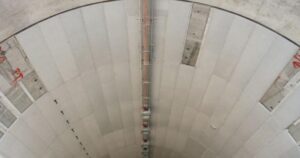
Aestuver fire protection boards are maintenance free and don’t require regular inspections.
According to the ETA the boards have design life of minimum 25 years. This does not mean that you need to replace the fire boards after 25 years. If there is no damage the fire protection panels can stay fixed and they will serve their purpose for many more years. In some tunnel conditions it may be even 50 to 60 years in total. However, it is very specific and depending on numerous factors. Therefore, you should consult us in order to get most reliable information.
Are there any tunnel fire boards you should avoid?
Yes, there are several types of fire boards which should not be used in tunnels. In general, tunnel operators should avoid using fire protection cladding which is not able to withstand tunnel environment, specifically – water ingress, high humidity, exposure to road cleaning chemicals and de-icing agents, etc.
One type of fire boards which is often mentioned in the specification as “not allowed” are magnesium oxide boards or MgO fire boards.
You can read more about this topic in another article – “Why magnesium oxide boards are not suitable for tunnels?”
and here’s a shorter summary of main information.
ITA (International Tunnels Association) published a guideline which cites findings from the research on MgO boards:
“The experiments described in the paper seem to indicate a relative humidity level of 84% RH as a limit above which the MgO boards that have been tested begin to
absorb excessive amounts of moisture from the surrounding air. Since this and higher values of relative humidity are typical in locations where exterior sheathing is to be
used, it can be stated that MgO-boards cannot be a suitable product for this use. This is supported by the numerous examples of failures, which have been seen in recent
years, where such boards leak salty water that cause damage on adjacent construction members of wood or metal, and which even over time lead to disintegration of the MgO board itself.”
“For this reason, it can be stated that MgO boards are not suited as sheathing in exterior facades or any other application where the boards are in contact with a moist climate. At
RH above approximately 84% RH the MgO boards will form drops of salty water on the surfaces, and this water will be absorbed in wooden structures in connection with boards and water absorption will increase and can lead to mould growth on wood. The MgO-board itself is also sensitive to mould growth due to the content of organic material. Furthermore, the MgO board will itself also be disintegrated over time when it is exposed to high humidity due to the dissolution of the salts it consists of. If metal
parts, such as galvanized steel, fasteners and flashings are in contact with MgO boards, they will start to corrode within short time, leading to safety problems in the structure. Sheathing with MgO boards are now being replaced by other types of materials in a great number of buildings in Denmark.”
Humidity levels in tunnels are often rather high, due to, for example:
• Water leaks of the tunnel structure
• In case of precipitation, moisture will be
carried into the tunnel by vehicles
• Washing activities to clean the tunnel
linings
• Meteorological circumstances
You can access the full document here:
Structural Fire Protection For Road Tunnels – ITA Working Group 6 Maintenance and Repair
or directly from here: Structural Fire Protection in Tunnels – Working Group 6 – Maintenance and Repair.
The quoted research paper is “Magnesium-oxide boards cause moisture damage inside facades in new Danish buildings”.
You can also access it here.
Last but not least the Hong Kong Highways authority in their “GUIDANCE NOTES ON DESIGN OF ROAD TUNNEL STRUCTURES AND TUNNEL BUILDINGS TO BE MAINTAINED BY HIGHWAYS DEPARTMENT” clearly states that tunnel’s thermal barrier (synonym of fire protection cladding) “should not be made of Magnesium Oxide (MgO)”.
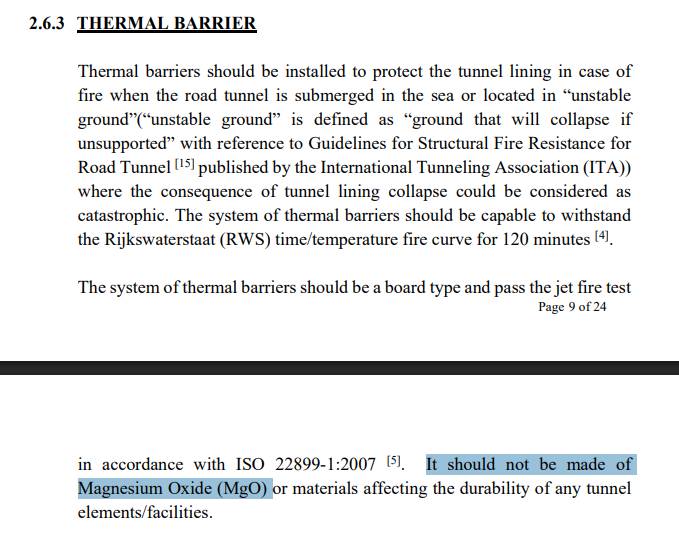
You can also access full document here.
All Aestuver boards are cement based tunnel fire boards and show superior durability in tunnels.
How to chose the correct thickness of the tunnel fire boards?
Thickness of the tunnel fire board depends on several factors. The main driving factor should always be the evidence from actual fire test. The fire board thickness will depend on the fire test duration and conditions under which it was tested, like the fire curve used for the tunnel design and fire test.
Fire board manufacturers can calculate theoretical thickness based on the heat load and duration of exposure to fire. However, this set-up has to be tested as the real life fire test may bring different results.
Sometimes project specifications mention that installers should use 25mm fire boards for tunnel protection. Nevertheless, this should not be the determining factor. The thickness of the tunnel fire boards should be selected by consulting the manufacturer who can provide fire test results.
Let’s take an example of a tunnel for which designers implement RWS 120 minutes fire curve requirements. Additionally, they specify that the surface of concrete behind the fire boards has to be lower than 380°C and temperature of the reinforcement to be lower than 250°C.
For this specification manufacturer of fire boards for tunnels may suggest different solutions. The fire board fixed directly to the tunnel surface may have higher thickness than the fire board fixed on the backing strips.
Backing strips help installation teams to overcome tunnel tolerances. These are installed behind the fire board joints. Such system makes installation of fire boards easier. What is more, backing strips act as an additional thermal barrier limiting the thermal load transfer between the fire board joints.
In case of Aestuver tunnel fire boards there are over hundred of fire tests. Therefore, the specifiers and engineers can rest assured that the product was tested in various configurations and for different fire curves.
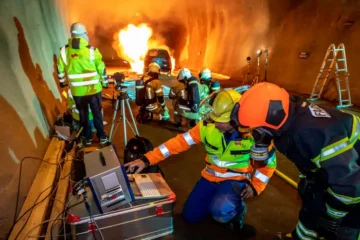
There is also a tendency for tunnel projects to carry out bespoke fire tests related to the specific tunnel project. These tests happen either in-situ, in case of the old tunnel that requires renovation. Or in a fire testing laboratory using the concrete slab built from the specified mix. It allows to test both the fire boards and tunnel concrete mix for spalling.

In-situ fire testing equipment – source efectis.com
What’s the cost of tunnel boards for fireproofing?
In another post we review the STUVA economical feasibility study on benefits of using tunnel fire protection panels. This article concentrates on the various aspects which tunnel operators need to consider. It describes the costs of installation, maintenance and repair of tunnel fire protection boards.
Selecting the right tunnel fire boards: Key Takeaways
I trust that this guide empowered you to choose the right fire protection board for your tunnel project. We highlighted Aestuver Tx fire boards for their versatility, durability, and ease of installation and cleaning.
Chose the long-term value: Aestuver Tx offers excellent fire protection, environmental resilience, and a long lifespan making it a smart investment in tunnel safety.
Aestuver Tx – tunnel fire protection board – technical data sheet – HERE.
Aestuver Tx – tunnel fire protection board – safety data sheet – HERE.
Aestuver Tx – tunnel fire protection board – EPD – HERE.
Aestuver Tx – tunnel fire protection board – European Technical Assessment document (ETA) – HERE.
Do you have a requirement for fire boards in your tunnel project? Contact us via the form below.

3 Comments
Passive Fire Protection in Tunnels - an introduction · 17 July 2024 at 5:55 pm
[…] Fire boards […]
What are the design fire curves for tunnels? - Tunnel Passive Fire protection - fire boards and fire cladding · 27 August 2024 at 2:57 pm
[…] fire testing before construction begins. For example, fire protection measures, such as the use of Aestuver® fire-protection boards, are preemptively tested to document their effectiveness in real fire […]
RWS fire curve - Tunnel Passive Fire protection - fire boards and fire cladding · 29 November 2024 at 11:19 am
[…] a fire. – Tunnel Fire Protection Systems – tunnel passive fire protection materials, fire boards or fire-resistant cladding, and ventilation systems are designed based on the temperature and […]